


Dental appointment card: what to include, layout and wording
At the front desk the sentence comes up every day: “I’ll write down your next appointment.” The dental appointment card is the simplest tool for the job, and yet it is often designed as an afterthought. It helps decide whether patients arrive on time, cancel early or forget the appointment altogether. Here you can read what belongs on a good appointment card, how to lay it out and how to make it last longer than the walk to the front door.
Appointment card, recall card, business card: the difference
The three cards are often lumped together, but they do different jobs:
- The appointment card records a fixed appointment: date, time, sometimes the treatment.
- The recall card reminds patients of a period in which the next visit is due and leads them to book. More on this in the article on the dental recall card.
- The business card introduces the practice or individual dentists. You will find ideas in the article on the dentist business card.
Many practices combine the three in one card system: the same design, the same colours, different backs.
What belongs on an appointment card
An appointment card has to be readable in a few seconds. These details have proven their worth:
- Practice name and logo, so the card is recognised at once.
- Date and time, large and with enough room to write them in.
- Treatment or dentist, if the practice has several surgeries or teams. An abbreviation is enough.
- Phone number for changes, clearly visible.
- A way to book online, such as a QR code leading to appointment booking or to an overview of appointments.
- Address and directions, especially helpful for new patients.
Less is more: opening hours for every weekday, service lists and long texts belong on your website, not on the appointment card.
Appointment series: orthodontics, implants, hygiene
For treatments with several sessions, a single field is not enough. For appointment series, plan three to five lines, each with a date and time. This applies above all to orthodontic check-ups, implant treatments in several steps and hygiene programmes over the year. A card with room for the whole series saves time at the front desk and gives patients an overview. For ideas aimed at practices with braces patients, see the article on promotional items for orthodontics.
Handling cancellations in a friendly way
A short sentence about cancelling helps avoid gaps in the appointment book. The tone matters: inviting rather than threatening. For example:
- “Can’t make it? Please let us know as early as you can, and we’ll offer the slot to someone else.”
- “Need to reschedule? Just call us or scan the QR code.”
If your practice has fixed rules for short-notice cancellations, word them as they have been agreed with patients, and if in doubt have the text checked legally.
Wording for the appointment card
Whether you use a formal or a relaxed tone follows the voice of your practice. A few examples that have worked well:
- “Your next appointment with us: ____ at ____”
- “We look forward to seeing you on ____”
- “Your appointments at a glance” (for appointment series)
- “Need to reschedule? Just scan.”
- For children: “Your next visit with us: ____. See you soon!”
Tip: Read the date and time aloud when you fill in the card. The card and the spoken word complement each other, and misunderstandings show up straight away.
Keeping the appointment card from getting lost
The classic paper appointment card has a problem: it has no use of its own. It disappears into a jacket pocket and only turns up again after the appointment. Two ideas give it more staying power:
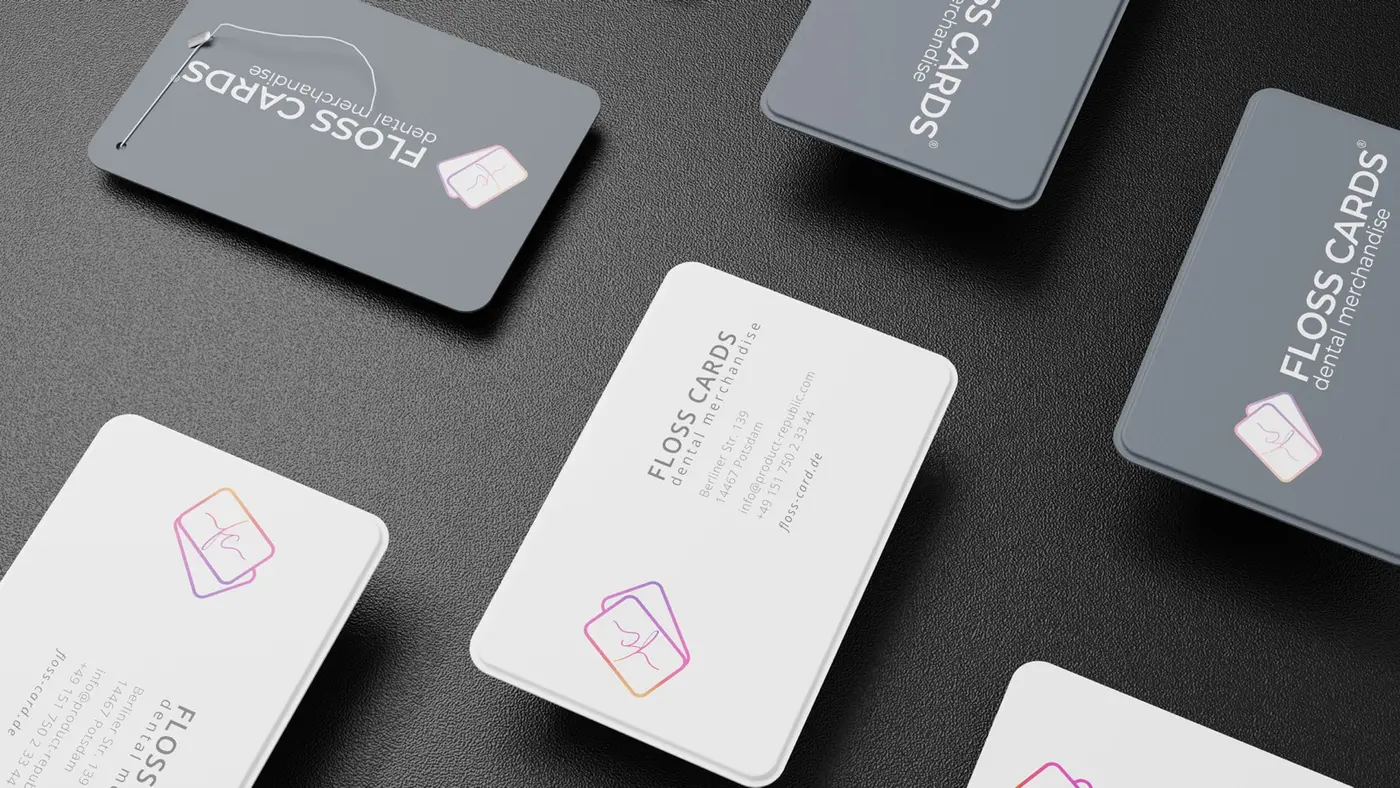
Appointment card with dental floss. The Floss Card in business card format (85 × 55 mm, 1.6 mm thin) contains around 10 metres of waxed dental floss and can be printed full-bleed on the front and the back. The front carries your practice, the back the way to the appointment, such as a QR code to the appointment overview and the phone number. Because the card stays in the wallet and gets used, your practice stays present between appointments too. In the card designer there are templates with lines for date and time for the appointment itself; they are filled in with a waterproof pen, because the card is made of plastic.
Greeting card with a Floss Card tucked in. Alongside the Floss Card you can choose a printed greeting card, for example in A6 format. The greeting card carries the fields for date and time or a whole appointment series, and the Floss Card tucked inside stays in the wallet as a companion. This works well at the start of a treatment or to welcome new patients.
What does an appointment card with dental floss cost?
Floss Cards are available from 500 pieces, printed full-bleed in CMYK on both sides. The unit price falls as the quantity rises (as of November 2026, excluding VAT): €1.20 for 500 pieces, €0.97 for 1,000 pieces, €0.76 from 10,000 pieces, plus a one-off €65 for print preparation. You add the greeting card as an upgrade. You can see the exact price for your quantity in the card designer.
Conclusion
A good dental appointment card is clear, written in large type and shows the easiest way to reschedule. Give it a use of its own, and it stays close at hand until the appointment.
Design your card in the card designer with a live preview and tiered pricing, or send us your logo through the request without a designer and we will design it for you. A free sample shows you how the card feels.
Your Floss Cards – designed in minutes
Live preview, transparent volume pricing, artwork upload. Or let us design them for you.
Keep reading
Christmas gifts for employees and clients: small ideas with a logo
Gift ideas for employees and clients at Christmas: small gestures with your logo that actually get used. With festive design, greeting texts, quantities and timing.
Dentist business card: content, design and ideas
What belongs on a dentist business card, how to lay out front and back, and how to turn it into a promotional item that patients actually keep and use.